Glynn May

Glynn May › Coming May 2027

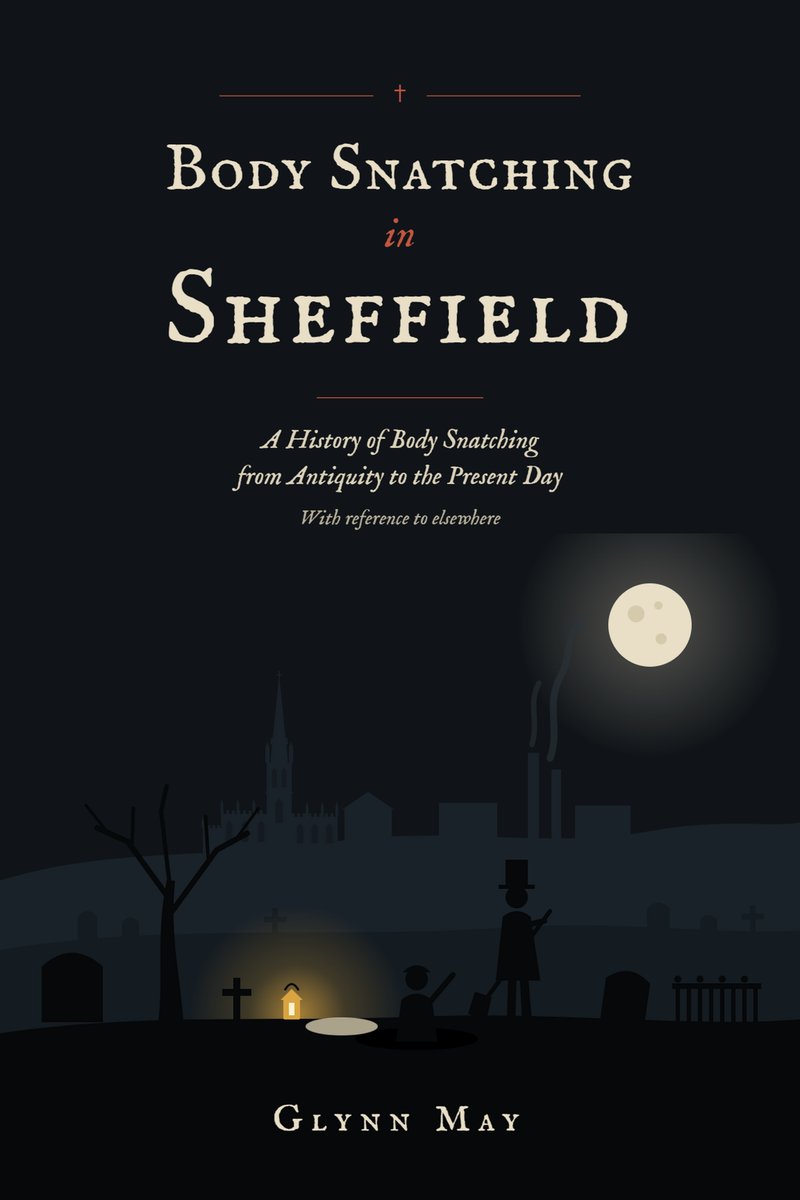
Front cover of Body Snatching in Sheffield by Glynn May: a moonlit Sheffield skyline with the cathedral spire, and two resurrection men with a lantern at an open grave
Cover · Body Snatching in Sheffield

Coming May 2027 · a new book by Glynn May, historian and lorewright

Body Snatching in SheffieldThe resurrection men, the watchers and the riots

On a November night in 1831, a Sheffield constable standing by a waggon warehouse in Arundel Street saw a man carrying a heavy load up the steps behind the Music Hall. It was the body of William Hopkinson, buried at Attercliffe a few days before.

This is the story of the men who stole Sheffield's dead, the families who sat up through the cold nights to guard their graves, and the crowds who rose against the anatomists.

Publication: May 2027. One email when the book is ready. Nothing else.

The story

In the early nineteenth century, Sheffield's dead were not always left in peace.

The town's medical school on Surrey Street, founded in 1828, needed bodies for anatomy teaching, and the law supplied almost none. The gap was filled by the resurrection men, who dug up the newly buried at night and sold them to the surgeons.

Sheffield people fought back. Families watched over the graves of their dead, and watch houses were built, like the one that still stands in the churchyard at Bradfield. When word got out that a grave had been robbed, crowds gathered. The Anatomy Act of 1832 changed the law, but it did not end the story.

Almost every name in this book comes from a newspaper column, a court register or a parish record.

Some of the cases

  • January 1829A rumour that a grave at St Paul's had been opened brought a crowd to Surrey Street, and the Medical Institution was stoned.
  • 1830Joseph Hall was sent to prison for six months for attempting to steal a body from the churchyard at Bradfield.
  • November 1831A Sheffield constable stopped Alexander Lyons in Arundel Street carrying the body of William Hopkinson, taken from the chapel yard at Attercliffe. Lyons was sentenced to two months' imprisonment.
  • 1835A crowd destroyed the Sheffield School of Anatomy.
  • June 1862Rumours that bodies were being taken from Wardsend Cemetery ended in a riot, and the sexton's house at Burrowlee was burned. No body was ever shown to have been sold, but the sexton, Isaac Howard, was imprisoned for three months for disinterring the dead.

What’s in the book

Eleven chapters in four parts, each one led by Sheffield:

  • The Road to Sheffield: how anatomy came to need the dead, from Alexandria to Georgian Britain.
  • Sheffield in the Age of the Resurrectionists: the tools and trade of the resurrection men, the Surrey Street school, Burke and Hare’s shadow over the town, the Anatomy Act of 1832 and the riots of 1835.
  • Sheffield After the Act: legal anatomy, lingering fear, the Wardsend scandal of 1862, and the long road from the workhouse to the body donor.
  • Sheffield and the Wider World: watchmen, mortsafes and coffin torpedoes, and how Sheffield compares with Scotland, Ireland, America and the body brokers of today.

With a Sheffield timeline, a map of the town’s resurrection sites, a guide to researching the records yourself, a glossary, and photographs of the places as they are now.

Built from the records

The book is drawn from original sources: the Sheffield Independent, Iris and Telegraph, Home Office criminal registers, West Riding Quarter Sessions indictment books, parish burial registers, the 1841 census, old trade directories and the newspaper cuttings at Sheffield Local Studies Library. Where the sources disagree, the book says so.

Can you help?

Anything you share will only be used with your permission, and credited if you wish.

I would like to hear from anyone with:

  • family stories of body snatching, grave-watching or riots in Sheffield and the surrounding villages
  • old photographs of churchyards, watch houses, mortsafes or the Surrey Street Medical Institution
  • letters, diaries or other papers that mention the resurrection men

Send a message

Or email glynnmay-author@pm.me.

About the author

Glynn May is a Sheffield historian and lorewright. He spent 25 years in NHS Management at all six of Sheffield’s NHS hospitals, working alongside senior medical staff. One of his roles was selling surplus medical assets at auction for Sheffield Teaching Hospitals, from a pair of forceps to a gamma camera, which gave him a first-hand knowledge of the instruments of medicine.

Body Snatching in Sheffield is his second book, and comes on the back of the success of his first, The Sheffield Royal Hospital: A History of a City’s Quest for Healthcare, published by 1889 Books in November 2026. More about Glynn · What is a lorewright?

Tell me when it’s published